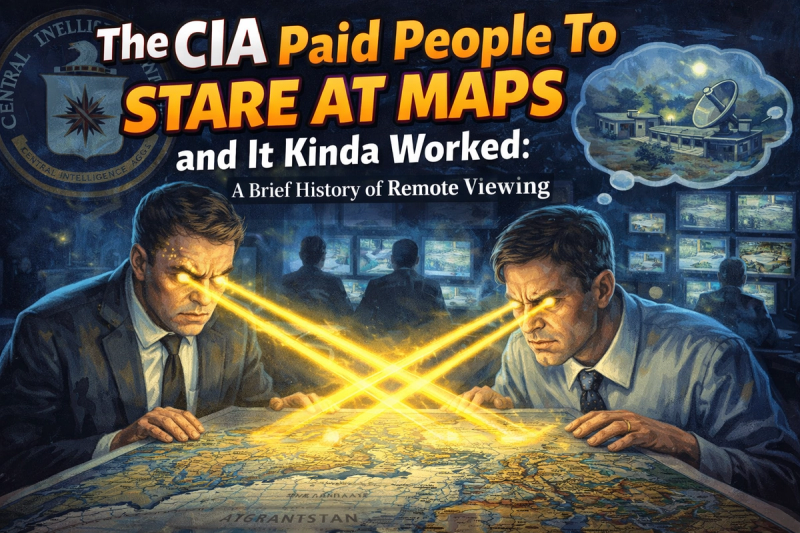
The CIA Paid People to Stare at Maps and It Kind of Worked: A Brief History of Remote Viewing
Between 1978 and 1995, the United States government ran a classified program where trained psychics attempted to gather intelligence by projecting their consciousness to distant locations. It was called Project STARGATE. It cost about 20 million dollars. And the declassified results are stranger than you'd expect — in both directions.
The program started at Stanford Research Institute in the early 1970s, when physicists Russell Targ and Hal Puthoff began experimenting with a man named Ingo Swann, who claimed he could perceive remote locations with unusual accuracy. The CIA was interested enough to fund further testing. What followed was nearly two decades of government-sponsored consciousness research, which is a sentence that would have sounded insane in 1977 and somehow sounds only slightly less insane now.
The methodology was specific: a viewer would be given a set of geographic coordinates and asked to describe what was there. No maps, no context, no hints. Just coordinates and a blank piece of paper. Some of the descriptions were vague enough to be useless. But some were not. There are documented sessions where viewers accurately described buildings, terrain features, and equipment at locations they had never visited and could not have researched. The hit rate was low. The hits themselves were hard to dismiss.
A 1995 review by the American Institutes for Research concluded that the statistical evidence for remote viewing was 'above chance' but that the intelligence value was questionable — the information was too vague or arrived too late to be operationally useful. The program was shut down. But the review also acknowledged something the government didn't loudly publicize: the effect appeared to be real. Whatever 'it' was, it was happening.
The honest position here isn't 'remote viewing is real' or 'remote viewing is nonsense.' It's more like: something happened in these experiments that we don't have a great explanation for, and the people who funded it were the ones with the most to lose from being wrong. That doesn't prove anything. But it does make the question more interesting than it would be if some enthusiasts in a garage had run the tests.
Go Deeper
Get the weekly PILLARS briefing. Research drops, case file updates, and stories that don't make the homepage.